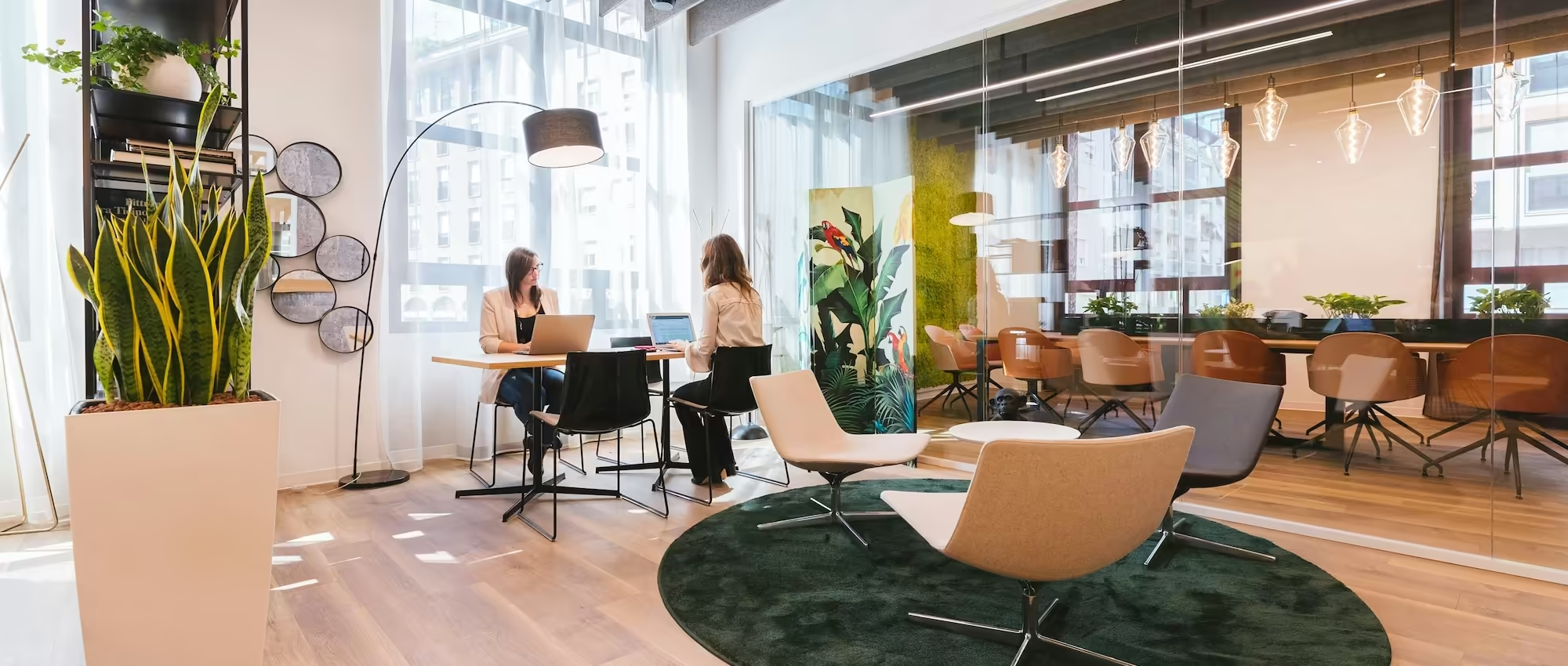
Office fitouts are often evaluated through the lens of upfront cost, but focusing only on initial expenditure can lead to decisions that reduce workplace performance and increase long-term operational inefficiencies.
The most effective office environments are not necessarily the most expensive — they are the most considered. They balance functionality, adaptability and build quality in ways that continue delivering value long after construction is complete.
Cost is immediate and measurable. Value is experienced over time through how effectively a workplace performs.
In office design, low upfront costs can sometimes create hidden operational challenges — inefficient layouts, inflexible spaces or poor coordination that impacts staff experience and business performance.
Value-driven design focuses on creating workplaces that remain functional, adaptable and relevant over the long term.
One of the most important investments in office design is the layout itself.
Good spatial planning improves circulation, workflow efficiency and team interaction while reducing wasted space.
Even premium finishes cannot compensate for a workplace that functions poorly on a day-to-day basis.
Businesses evolve over time, and office environments should be capable of adapting alongside them.
Flexible planning strategies allow spaces to accommodate changes in staffing, technology and operational needs without requiring major reconstruction.
Investing in adaptability early can reduce future disruption and renovation costs.
Material selection should consider long-term durability, maintenance requirements and suitability for the intended level of use.
Lower-cost materials may appear attractive initially but can deteriorate quickly in high-use commercial environments.
Investing in durable finishes often provides better long-term value through reduced maintenance and replacement requirements.
Office fitouts involve multiple disciplines, including architecture, mechanical systems, electrical services and fire compliance.
Poor coordination between these systems can lead to construction clashes, redesign and delays during delivery.
ISA™ applies ISO-certified quality management systems to ensure detailed coordination and documentation throughout the design process.
Office design directly influences how people experience the workplace.
Environments that support collaboration, focus and operational clarity contribute positively to staff satisfaction and organisational culture.
While workplace outcomes cannot be reduced to design alone, the quality of the environment plays an important supporting role.
Modern workplaces rely heavily on integrated technology infrastructure.
Failing to consider data, audiovisual systems and future technology requirements early can lead to inefficient retrofits later.
Early integration ensures technology supports the workplace seamlessly rather than becoming an afterthought.
Compliance with building regulations, accessibility standards and workplace safety requirements is fundamental in office design.
Attempting to minimise costs in these areas can create approval issues, operational risks and long-term liabilities.
ISA™ incorporates safety and compliance considerations into every stage through structured ISO 45001 aligned processes.
Construction documentation is one of the most underestimated aspects of office design.
Incomplete or unclear documentation increases the likelihood of inconsistent pricing, site variations and construction delays.
Investing in clear and coordinated documentation helps reduce ambiguity and improve delivery outcomes.
Short-term thinking in office design often prioritises trends or immediate savings over long-term usability.
Workplaces that age well are typically those designed with clarity, adaptability and operational efficiency in mind.
Long-term value is created when design decisions continue supporting the business years after occupation.
Architects are required to provide responsible and informed advice that considers compliance, functionality and buildability.
This includes helping clients understand the long-term implications of design and construction decisions.
ISA™ reinforces this responsibility through ISO-aligned systems that support accountability, consistency and coordinated project delivery.
Effective spatial planning, flexibility, durable materials and coordinated delivery all contribute to long-term workplace performance.
Not necessarily. Lower upfront costs can sometimes lead to operational inefficiencies or higher maintenance requirements later.
Flexible workplaces can adapt more easily to changing business needs over time.
Clear documentation improves pricing accuracy, coordination and construction outcomes.
Through architect-led design supported by ISO-certified systems focused on quality, safety and long-term functionality.
Office design should not be evaluated purely by upfront cost. The real measure of success is how effectively the workplace performs over time.
By investing strategically in planning, coordination and long-term functionality, businesses can create office environments that continue delivering value well beyond the completion of the fitout.
Copyright © 2026 ISA™. All Rights Reserved.