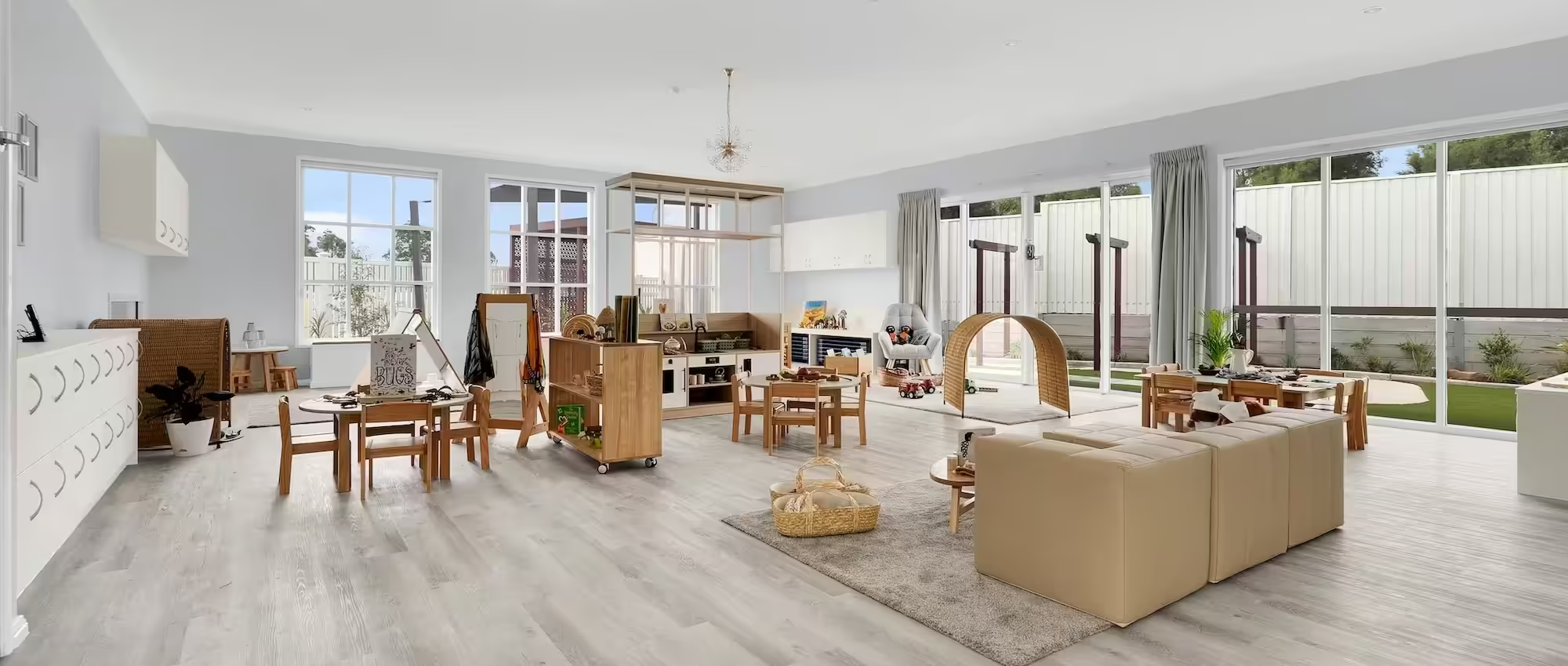
From the outside, many childcare centres look similar. Bright colours, playful graphics, and familiar layouts give the impression that they’re all designed to do the same thing. But step inside, and the difference between a centre that truly works and one that merely complies becomes immediately obvious.
At ISA™, we’ve seen firsthand how thoughtful design can transform daily operations, staff wellbeing, and children’s experiences — and how poor design quietly creates stress, inefficiency, and long-term cost.
One of the biggest misconceptions in childcare design is that size alone determines quality. In reality, flow matters far more than raw square metres.
In centres that work well, movement is intuitive. Children transition smoothly between rooms and outdoor areas. Educators aren’t constantly crossing paths or backtracking. Parents can drop off and pick up without congestion or confusion.
Poorly designed centres often meet minimum area requirements but fail to consider how spaces connect. The result is bottlenecks, supervision challenges, and daily friction that wears down staff over time.
Effective supervision isn’t achieved by asking educators to “work harder.” It’s achieved through spatial clarity.
In well-designed centres, sightlines are deliberate. Rooms are arranged so educators can oversee multiple activity zones without feeling exposed or overwhelmed. Transitions between indoor and outdoor spaces are visible and controlled.
Centres that struggle often rely on procedural fixes for spatial problems — additional staffing, rigid routines, or restricted access — all of which increase operational cost and reduce flexibility.
One of the clearest indicators of whether a childcare centre truly works is how it supports its educators.
Centres that perform well provide staff with clear circulation, functional storage, appropriate amenities, and spaces to pause and reset during long days. These aren’t luxuries — they’re fundamental to retention and morale.
In contrast, many centres sacrifice staff functionality to maximise enrolment numbers, only to face burnout, turnover, and recruitment challenges later.
Children don’t all learn or play the same way at the same time. Centres that work accommodate this naturally through flexible spatial planning.
Rather than rigid rooms with single-purpose layouts, successful centres allow for simultaneous activities — quiet engagement, group interaction, and guided learning — without constant reconfiguration.
Poorly designed centres attempt flexibility through movable furniture alone, but without architectural support, these spaces quickly become cluttered and difficult to manage.
Outdoor space is not a break from learning — it’s an extension of it.
In centres that work, outdoor areas are directly connected, easily supervised, and usable throughout the day. They aren’t treated as isolated zones accessed only at set times.
Centres that struggle often relegate outdoor areas to compliance requirements, resulting in underused spaces that add little value to daily routines.
Meeting regulations is non-negotiable. But centres designed only to satisfy minimum standards rarely perform well in practice.
Successful childcare environments treat compliance as a starting point, not an endpoint. Design decisions go further — anticipating how spaces will be used, adapted, and maintained over years of operation.
This foresight reduces operational friction and protects the long-term value of the centre.
Many childcare projects look impressive during approvals but lose clarity during construction due to unresolved details or oversimplified documentation.
Centres that work are designed with construction in mind. Details are resolved early, materials are chosen for durability, and layouts account for real-world use — not just visual impact.
This alignment between design and delivery is what allows the centre to function as intended from day one.
Stress is often a result of poor flow, inadequate supervision lines, and lack of staff support spaces — all design-related issues.
No. Well-planned smaller centres often outperform larger ones due to better circulation and operational clarity.
Absolutely. Centres that support educators through thoughtful layouts and amenities consistently experience better retention.
As early as possible. Early involvement helps avoid compliance-driven layouts that don’t work operationally.
Designing to tick boxes rather than to support daily life inside the building.
A childcare centre that works isn’t louder, brighter, or more complicated. It’s calmer, clearer, and easier to operate.
When design supports educators, children benefit — and when children thrive, the entire centre succeeds. That’s the difference between a childcare centre that simply exists and one that truly works.

Copyright © 2026 ISA™. All Rights Reserved.