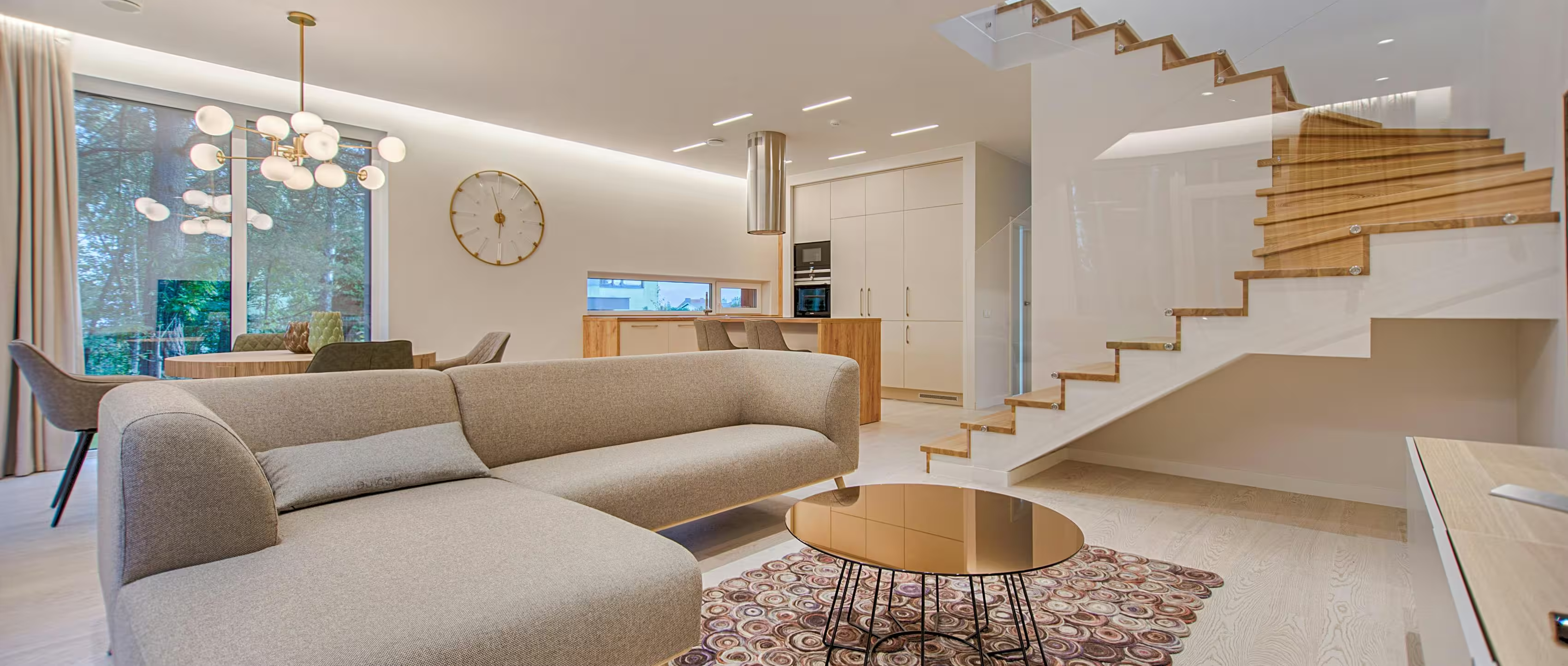
Some spaces change the way you behave the moment you enter them. Your voice lowers. Your pace slows. You become more aware of where you are and how you move through it. These spaces don’t rely on size, expense, or ornament — they rely on intention.
In architecture, this quality is often described as sacredness. Not in a religious sense, but as a feeling of presence, gravity, and meaning. It’s the difference between a room that is simply functional and one that feels considered, grounded, and quietly powerful.
A common misconception is that sacred spaces require a particular aesthetic — stone walls, dramatic lighting, or minimalist restraint. In reality, sacredness has very little to do with style.
It emerges from proportion, sequencing, and restraint. A modest room can feel deeply considered, while a grand space can feel hollow if its design lacks clarity. Sacredness is not added at the end; it is embedded from the first decision.
One of the most powerful tools in creating a sacred atmosphere is the threshold. The moment of transition — from outside to inside, from public to private — sets the tone for everything that follows.
Compression before release, a change in material underfoot, or a subtle shift in ceiling height signals that you are entering a different condition. These moments don’t announce themselves loudly, but they register instinctively.
Humans are deeply responsive to proportion, even if we can’t articulate why. Rooms that feel calm and grounded often share common proportional relationships — balanced heights, considered widths, and a sense of containment without confinement.
When proportions are rushed or arbitrary, spaces feel unsettled. When they are deliberate, they invite stillness. This is one of the clearest distinctions between spaces that feel designed and those that feel merely assembled.
Sacred spaces are rarely cluttered. This doesn’t mean they are empty — it means they are edited. Every element earns its place, and nothing competes for attention.
Visual noise erodes presence. Clean junctions, resolved edges, and controlled detailing allow the mind to rest. Silence, in architectural terms, is the absence of unnecessary interruption.
In meaningful spaces, light is not used theatrically. It is directional, purposeful, and often restrained. Light reveals form, guides movement, and reinforces hierarchy.
Rather than flooding every surface, sacred spaces often privilege certain moments — a wall, a threshold, or a focal point — allowing contrast to do the work. The result is depth, not drama.
Material integrity plays a quiet but critical role. Spaces feel grounded when materials behave as expected — when weight looks heavy, structure looks structural, and finishes are not pretending to be something they’re not.
This honesty builds trust. When materials feel authentic, the space feels stable. When materials are purely cosmetic, the experience becomes shallow.
Sacredness often emerges not from what is included, but from what is deliberately left out. Over-design dilutes meaning. Restraint concentrates it.
By limiting gestures and repeating them consistently, architecture gains authority. The space feels intentional rather than expressive, confident rather than performative.
No. Sacredness is about clarity and intention, not silence or minimalism. A space can be richly detailed and still feel grounded if every element is purposeful.
Absolutely. Entry sequences, private rooms, and moments of pause within a home can all carry a sense of gravity when designed with care.
Yes — but it requires discipline. Sacredness comes from planning relationships, proportions, and transitions early, not from decorative decisions later.
Cost does not equal meaning. Without restraint and clarity, scale and expense can amplify emptiness rather than resolve it.
We focus on sequencing, proportion, and buildable clarity — ensuring spaces feel deliberate, calm, and resolved from the inside out.
A sacred space doesn’t demand attention — it earns it. It’s felt more than it’s seen, and remembered long after the details fade.
At ISA™, we believe architecture carries responsibility. When spaces are designed with restraint, honesty, and intent, they shape behaviour, mood, and memory. And that is where architecture moves beyond construction — into meaning.

Copyright © 2026 ISA™. All Rights Reserved.