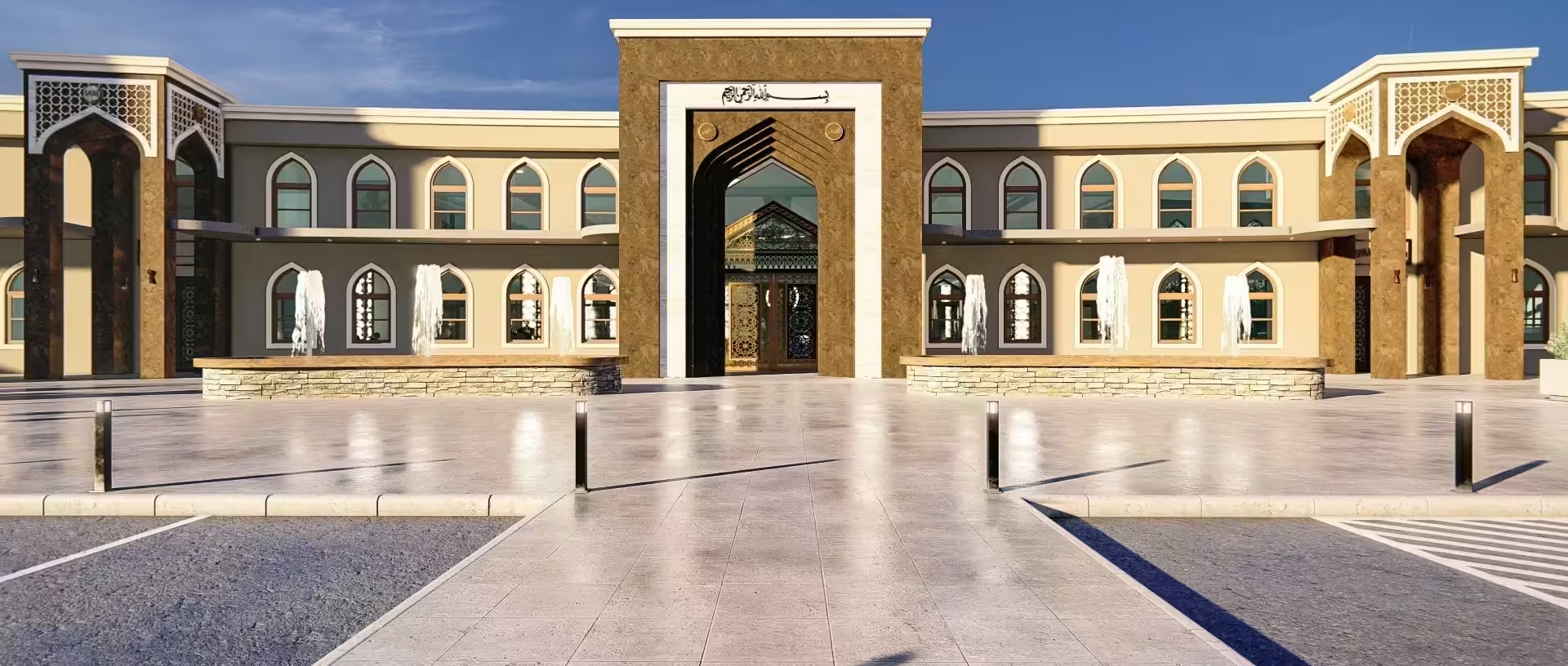
Some projects change how you design forever. Our mosque project was one of them.
Not because of scale or complexity alone, but because it demanded a deeper level of listening, cultural understanding, and responsibility than most buildings ever will. It reinforced a belief we hold strongly at ISA™ - architecture carries meaning far beyond form.
A mosque is not simply a gathering space. It is a place of worship, identity, ritual, and community memory. Every design decision carries symbolic weight, whether intentional or not.
From spatial hierarchy to orientation, circulation, and thresholds, the building must respond to centuries of tradition while serving the practical needs of a contemporary community. This balance cannot be achieved through assumption or aesthetic mimicry.
It requires humility — acknowledging that the architect is not the cultural authority in the room.
One of the earliest lessons from the project was the importance of slowing down the design impulse. Before lines were drawn, time was spent listening — to community leaders, elders, and future users.
These conversations went beyond functional requirements. They explored values, rituals, sensitivities, and aspirations. What does welcome look like? Where does privacy matter most? How should spaces transition from public to sacred?
The answers shaped the architecture more than any reference image ever could.
In culturally significant projects, respect lives in the details. It shows up in how people enter a space, how sightlines are managed, and how materials are used.
Seemingly small decisions — the placement of entries, separation of circulation paths, or the proportions of prayer spaces — have profound implications for how the building is experienced.
These are not aesthetic gestures. They are architectural acknowledgements of belief, practice, and dignity.
Cultural architecture is often misunderstood as restrictive. In reality, it creates a framework within which meaningful innovation can occur.
Rather than replicating historical forms, the project challenged us to reinterpret principles in a contemporary context — using modern construction methods while honouring traditional spatial logic.
The result is architecture that feels rooted without being nostalgic, and progressive without being disconnected.
Unlike many projects where users are abstracted, this process kept the community visibly present throughout. Their feedback was not an afterthought — it was integral to refinement.
This approach required patience and clarity. Not every suggestion translates directly into built form, but every concern deserves to be understood.
The trust built through this process ultimately strengthened the design and its acceptance.
The project also highlighted architecture’s role beyond the site boundary. A mosque is both inward-looking and outward-facing — serving its congregation while existing within a broader civic context.
Thoughtful design can help demystify, welcome, and foster understanding. The building becomes a bridge rather than a barrier.
This responsibility extends to scale, presence, and how the building engages the street and neighbourhood.
The mosque project sharpened our awareness of the weight architecture carries. It reinforced that good design is not about imposing ideas, but about translating values into space.
It also reaffirmed our commitment to process — to research, dialogue, and careful decision-making — especially when working within culturally sensitive contexts.
These lessons now inform every project we take on, regardless of scale or typology.
Yes. The cultural, symbolic, and communal dimensions are far more pronounced, requiring deeper consultation and sensitivity.
By listening first and treating the community as knowledge holders rather than clients to be instructed.
Absolutely. Tradition is not a fixed form — it’s a set of principles that can be reinterpreted thoughtfully.
It can extend early stages, but it significantly reduces conflict, redesign, and misunderstanding later.
That architecture succeeds when it serves people with respect, not ego.
The mosque project reminded us that architecture is never neutral. It carries cultural, social, and emotional weight whether we acknowledge it or not.
When approached with care, humility, and intent, architecture can honour tradition while supporting progress — and that is where its true power lies.

Copyright © 2026 ISA™. All Rights Reserved.